Connecting Through Song on Georgian Bay

In 1837, while journeying through the Upper Great Lakes, influential British writer Anna Jameson documented the daily rhythms of canoe travel, noting the powerful presence of music among her Métis guides and paddlers. Jameson noted how the men sang as they paddled, their lively and unified voices rising together across the water.
Among those Métis singers was Lewis (Louis) Solomon, whose voice left a particularly strong impression:
“The men sang their gay French songs, the other canoe joining in the chorus… Louis was great in ‘Trois canards s’en vont baignant.’”
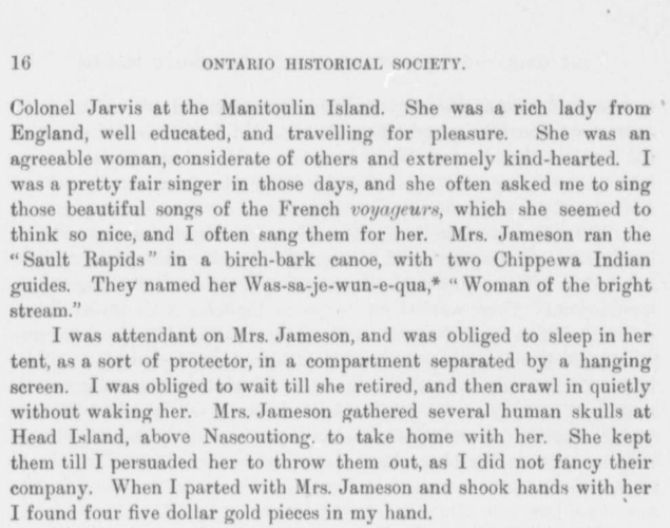
Many years later, as an elderly man, Lewis Solomon reflected on that same journey and his encounters with Jameson. He remembered her as kind and curious, deeply appreciative of the songs she heard, which became a shared language that bridged cultural differences:
“I was a pretty fair singer in those days, and she often asked me to sing those beautiful songs of the French voyageurs, which she seemed to think so nice, and I often sang them for her.”
Their connection extended beyond music. Solomon served as Jameson’s attendant during the journey, a role that brought them into close daily contact and fostered trust:
“I was attendant on Mrs. Jameson, and was obliged to sleep in her tent… in a compartment separated by a hanging screen… and then crawl in quietly without waking her.”
This arrangement reflects both the realities of travel and the personal bond that developed between them. Together, Jameson’s observations and Solomon’s recollections reveal how song functioned as more than accompaniment to travel. It reinforced Métis identity while also creating moments of closeness and exchange.
See Our Sources
Mini Word Search
Have fun with the facts by completing today's mini word search.